Industrial canvas weaving machines belong to the textile industry and produce high-strength fabrics for demanding industrial applications. In contrast, hydraulic forging hammers serve heavy industry by shaping metal components under immense force. Although these two types of equipment operate in different sectors, they share a deeper and often overlooked connection.
Rather than relying on direct mechanical interaction, their relationship reflects interdependence in materials engineering, structural design, precision manufacturing, and long-term industrial evolution. Together, they illustrate how upstream heavy industry quietly supports downstream textile machinery, thereby forming a continuous and resilient industrial value chain.
What Defines an Industrial Canvas Weaving Machine
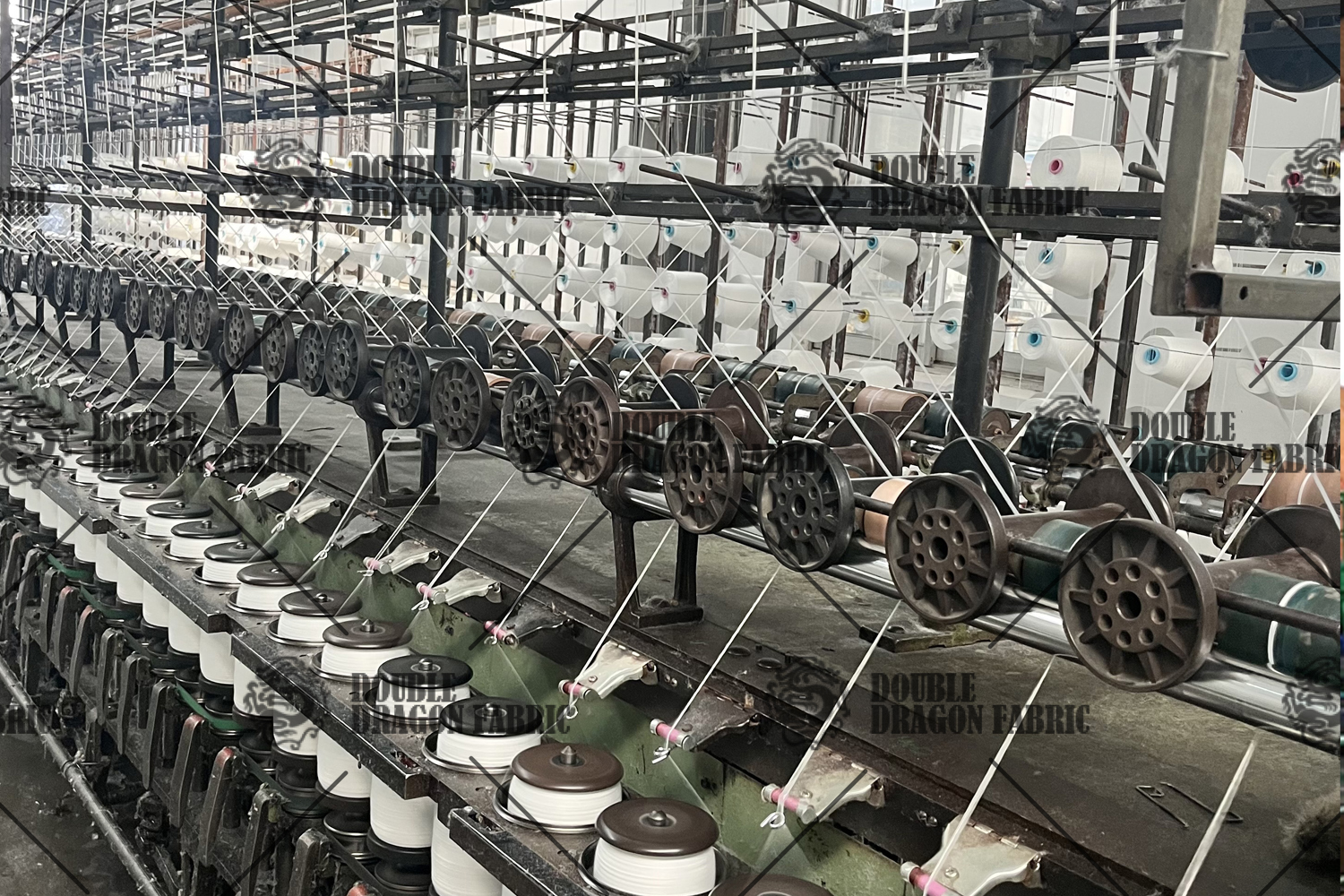
Industrial canvas weaving machines manufacture heavy-duty woven fabrics used in applications such as conveyor belts, air slide fabrics, filtration systems, tents, tarpaulins, inflatable structures, and protective covers. Unlike apparel looms, these machines process thick yarns, withstand high tension loads, and operate continuously over long production cycles.
To meet these demands, manufacturers design canvas weaving machines to maintain dimensional stability while running at high speeds and under constant mechanical stress. As a result, every major structural component—from the main frame to the drive shaft—must deliver high strength, strong fatigue resistance, and precise alignment.
Why Structural Strength Matters in Canvas Weaving
Because industrial canvas yarns commonly use polyester, nylon, aramid, or blended fibers, weaving machines must apply significant force during shedding, beating-up, and take-up processes. Even minor deformation in the machine frame or motion system can immediately affect fabric density, weave uniformity, and long-term operational reliability.
For this reason, industrial canvas weaving machines resemble heavy machinery more closely than traditional textile equipment. Consequently, manufacturers increasingly rely on advanced metal-forming technologies to produce their structural components and motion parts.
Why Forging Remains Essential in Precision Machinery
Hydraulic forging hammers use pressurized hydraulic systems to deliver controlled and repeatable impact forces that shape metal billets into high-strength components. Unlike mechanical hammers, hydraulic systems allow operators to precisely control forging force, stroke length, and deformation speed.
Forging enhances metal integrity by aligning internal grain flow with the final shape of the component. As a result, forged parts consistently outperform cast or fully machined alternatives in strength, fatigue resistance, and service life. For machinery that operates continuously—such as industrial canvas weaving machines—this performance advantage proves indispensable.
Structural Components Link the Two Industries
The connection between industrial canvas weaving machines and hydraulic forging hammers becomes clear when we examine how manufacturers produce key machine components. Many of the most critical parts in weaving machines rely on forged steel rather than fabricated or cast materials.
Forged components commonly appear in load-bearing and motion-critical areas, including crankshafts, eccentric shafts, drive hubs, rocker arms, and bearing housings. Hydraulic forging hammers shape these components before manufacturers perform machining, heat treatment, and final assembly.
At this stage of the industrial process, textile machinery manufacturers indirectly depend on forging technology to achieve the reliability, accuracy, and durability their equipment requires.
Parallel Engineering Requirements
Although canvas weaving machines and hydraulic forging hammers perform different functions, engineers design both systems around similar mechanical principles. Both must manage dynamic loads, absorb vibration, maintain dimensional accuracy, and operate reliably over extended service intervals.
This overlap explains why advances in forging technology often influence textile machinery design. Stronger forged alloys, tighter dimensional tolerances, and improved surface integrity allow weaving machines to operate at higher speeds while maintaining consistent fabric quality.
The Mid-Process Connection in Manufacturing
At the midpoint of the manufacturing ecosystem, the relationship between these two types of equipment becomes more apparent. Component suppliers, machinery OEMs, and system integrators frequently rely on the same forging workshops, material specifications, and quality standards to serve multiple industries.
At this stage, several shared technical priorities naturally emerge:
- Manufacturers demand high-strength forged shafts to resist torsional fatigue during continuous weaving operations.
- Equipment builders require forged frames and brackets to minimize deformation caused by long-term vibration.
- Design engineers depend on forging consistency to ensure repeatable machine geometry across production batches.
- Maintenance teams benefit from forged components that extend service life and reduce unplanned downtime.
Together, these priorities highlight how hydraulic forging hammers quietly support textile machinery performance, even though they never appear on the production floor of a weaving plant.
Key Components Bridging Both Technologies
The following table illustrates how hydraulic forging hammers contribute to the production of critical components used in industrial canvas weaving machines:
| Forged Component | Produced by Hydraulic Forging Hammer | Function in Canvas Weaving Machine |
| Main Drive Shaft | Yes | Transmits rotational power under high torque |
| Eccentric Shaft | Yes | Controls shedding and motion timing |
| Bearing Housing | Yes | Maintains shaft alignment and load distribution |
| Structural Bracket | Yes | Reinforces frame rigidity and vibration resistance |
| Flywheel Hub | Yes | Stabilizes rotational energy during weaving cycles |
This table demonstrates that while the two machines never interact directly, one depends on the other at a fundamental manufacturing level.
Conclusion
So, is there a connection between industrial canvas weaving machines and hydraulic forging hammers? The answer is yes—but not in an obvious or direct mechanical sense. Instead, the connection runs through materials science, component manufacturing, structural engineering, and shared industrial priorities.
Hydraulic forging hammers enable the production of strong, precise, and durable components that canvas weaving machines rely on to operate efficiently and reliably. Without advanced forging technology, modern industrial weaving would struggle to meet growing demands for speed, consistency, and long service life.
More broadly, this relationship demonstrates how modern manufacturing functions as an interconnected system. Even machines that appear unrelated often depend on the same foundational technologies. By understanding these hidden links, manufacturers can make better design decisions, improve equipment performance, and build more resilient industrial ecosystems.